Another day, another view from the porthole. This time we awoke in the port of Athens with high hopes for a great day of sightseeing.

I had been to Athens once upon a million years ago and sadly remember very little of that visit… which made this one all the sweeter. Let’s do a run-down of the highlights: literally.
This shore excursion was one of our longest and included a LOT of driving. A lot! Just getting anywhere in Athens takes a monumental effort. (See what I did there?) Plus, there was lunch and a jaunt waaaaaaay out of the city to another location. So, we geared up with all the things- water, phones, extra charging packs, sunscreen and happily boarded our bus.
Without my camera.
Perfect.
Ah well, whatcha gonna do?
Just before our bus let us off at the foot of the Acropolis, we were incredibly lucky enough to have the Presidential Guard of Athens march right beside us! Our guide, sadly not the best one, but still very, very knowledgeable and personable (just unbelievably difficult to understand at times), made sure to let us know that that was something really very special to have come across. Unfortunately, this was the best, but not-so-up-close, shot I could get.

Still, it was pretty cool to see them at all without having to go to the Athens Tomb of the Unknown Soldier. In case you are interested in learning more about their elite guard, here is the Wiki article on their regalia, duties, history, etc…
https://en.wikipedia.org/wiki/Presidential_Guard_(Greece)
A short word about Tour Guides in Greece… Every tour guide that is registered and licensed has been to school, actual school, to be one. It is the equivalent of a 2-year degree here in the States. Lessons cover ALL of Greek history, EVERY major monument, historic site, and archeological thing, in ALL of Greece. They take a trip to each one and practice giving a tour with all of the expected information and be able to answer questions as well. I was humbly impressed at the level of professionalism and skill at not only knowing their proverbial doo-doo, but with how they can keep a generally clueless bunch of foreigners on task and on time. They have to keep a tight schedule and are ultimately responsible for getting their group back to the dock or tender safely and on time.
The bus driver let us off at the designated drop-off spot and our tour guide pointed out the rendezvous location. Oddly, it happened to be at one of her family member’s souvenir shops where people could end their time in the Parthenon area by, wait for it….
… shopping for crap made in China that no one really needs but seem to buy anyway.
From the “bottom” of the “hill”:

Dad decided to join us on this day out and the three of us started the long trek up the Acropolis. Okay, it wasn’t that bad or that dramatic; all told I think we got to the top in about 15-20 minutes by way of mostly cement sidewalks.
And a lot of steps!
And with a LOT of people.

I think that was last we all saw of each other for the next 2 hours. Possibly more, I have no idea. With each of us going at our own pace, seeing the particular parts and places we were most drawn to, and letting our hearts take our feet wherever they led, the morning gave us glorious light.
The golden sun filtered through the columns casting a perfect glow on the off-white marble; the cloudless blue sky gave a stunning contrast to the perfect lines of the Parthenon. We truly lucked out at the timing of our visit as the lighting was absolutely superb.
Parts of the path were easily accessible, but only to a certain point. Most approaches to the edges of the buildings, as far as permissible, were very uneven and rocky. For those of you who may be planning a visit, there were also escorted elevators to the lower levels back down for those in need.
Photo to show you the rocky area.

Clearly, this is an active archeological restoration site marked by the unsightly crane and scaffolding.


And clearly most of this ancient temple of Athena was destroyed- earthquakes, time, and pillaging have all taken their toll. But what is still standing (or has been reconstructed) is pretty fabulous. I’ll bet you’re wondering what a “metope” is.
**** Caution, long bit of dryish history and architecture. Skip if you need to.****
I came across that word when doing a bit of research for this chapter and learned that “metopes” are described as: “The Doric entablature includes a frieze composed of trigylphs (vertical plaques with three divisions) and metopes (square spaces for either painted or sculpted decoration). The columns are fluted and are of sturdy, if not stocky, proportions.” In the case of the Parthenon, “The frieze of the Parthenon’s entablature contained 92 metopes, 14 each on the east and west sides, 32 each on the north and south sides. They were carved in high relief, a practice employed until then only in treasuries (buildings used to keep votive gifts to the gods). According to the building records, the metope sculptures date to the years 446–440. The metopes of the east side of the Parthenon, above the main entrance, depict the Gigantomachy (the mythical battle between the Olympian gods and the Giants). The metopes of the west end show the Amazonomachy (the mythical battle of the Athenians against the Amazons). The metopes of the south side show the Thessalian Centauromachy (battle of the Lapiths aided by Theseus against the half-man, half-horse Centaurs). Metopes 13–21 are missing, but drawings from 1674 attributed to Jaques Carrey indicate a series of humans; these have been variously interpreted as scenes from the Lapith wedding, scenes from the early history of Athens, and various myths. On the north side of the Parthenon, the metopes are poorly preserved, but the subject seems to be the sack of Troy.”“In March 2011, archaeologists announced that they had discovered five metopes of the Parthenon in the south wall of the Acropolis, which had been extended when the Acropolis was used as a fortress. According to Eleftherotypia daily, the archaeologists claimed the metopes had been placed there in the 18th century when the Acropolis wall was being repaired. The experts discovered the metopes while processing 2,250 photos with modern photographic methods, as the white Pentelic marble they are made of differed from the other stone of the wall. It was previously presumed that the missing metopes were destroyed during the Morosini explosion of the Parthenon in 1687.” – Wiki
Okay, enough of that. I know it’s tedious.
Here instead, is a bit more tedium:
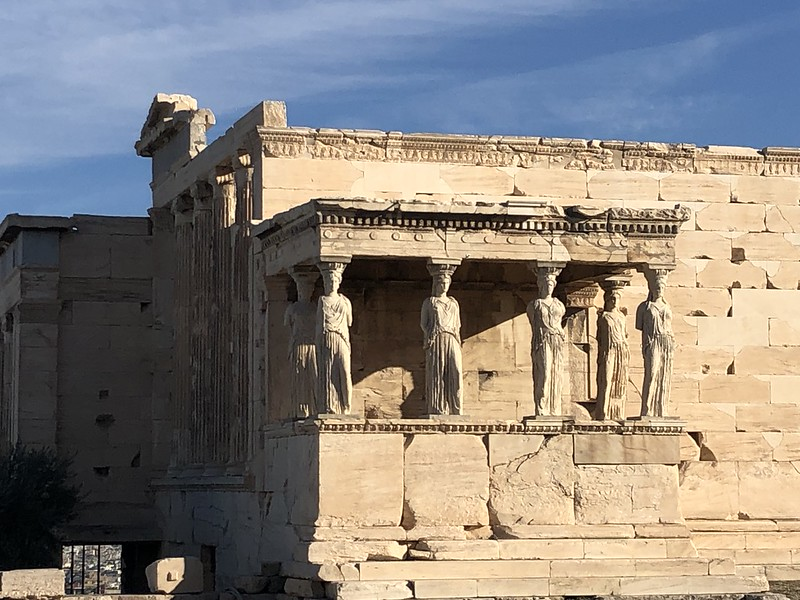
Instead of spending most of my time where the hordes were, I headed off to one of the other buildings (there are 4 on the Acropolis) called the Erechtheion. This is where the exquisite Porch of the Maidens is, and oh, how the golden hour made them sing!


Just beautiful! There were hardly any people over on that side and I loved having the opportunity to take some people-free photos. While the Parthenon is certainly more grand in terms of size, the Erechtheion is far more “remarkably luxurious” in its sculptures and detailing, according to Wiki.
https://en.wikipedia.org/wiki/Erechtheion#Sculpture
Saying goodbye to the ladies, I wound my way back over the rocky, uneven terrain to overlook the Theater of Dionysus. It was only excavated and reconstructed in the 19th century. And I gotta say, it was impressive. Best part? We had seen 3 theaters up to this point (it would be our last)- Ephesus, Delos, and now Athens. Ephesus and Delos were mostly un-restored and more “ancient-ruiny”. They gave a cool sense of “old”, but this one helped us see what it might have actually been like in the days of Grecian Tragedy and Comedy. According to Wiki, the theater reached its zenith in the 4th C. BC. There are still theater events and concerts today should you be so inclined.
Or have the money.

As I made my way back towards the walkway that led down off the Acropolis I came to a spot where you could overlook Mars Hill. While its history is quite extensive in terms of ancient political happenings, one that I’m most familiar with is from Acts 17:16-34 (where Mars Hill, or “the Areopagus”) prominently features the Areopagus as the setting for the Apostle Paul’s Areopagus sermon during his visit to Athens, notably leading to the conversion of Dionysius the Areopagite. However, it is unclear whether Paul gave his speech before the Areopagus council in the setting of a judicial investigation or trial, or on the physical location of the Areopagus hill as an informal speech. Additionally, the Areopagus likely would not have met on the actual Areopagus hill by the time of Paul’s visit, but rather in the agora or the Stoa Basileios.” It was wonderful to see in real life places I’d only read about up until then.

With a few texts and a lot of frustration we finally found each other and decided we had enough time still for some coffee and a snack. I ended up with a wonderful “Freddo Espresso” and a large hunk of spanakopita. YUM!!! HELLO!, Beautiful, let’s find a place to enjoy you. “Freddo Espresso is unique and is made out of espresso and blended in a frappe coffee frother. The Freddo Espresso is topped with a cold milk-based foam known as aphrogala in Greece. The drink is traditionally served over ice and many enjoy it with sugar or stevia.”- A random internet site.
The three of us found a lovely place in the sun to enjoy our snack and we still had some time to kill. Naturally, I found my way to the appointed souvenir shop where I would end my time in the Parthenon area by shopping for crap made in China that no one really needs but seem to buy anyway.
My goal for this trip was to keep the “stuff” to a minimum and focus on taking away an array of wonderful memories. I think I accomplished both perfectly. What I ended up with was a little “something” from each of the major regions we went to over the course of the whole trip. For those of you who’ve followed me for a very, very long time on another blogsite prior to writing here, I have done what I call my “Shop-Around-the-World game” in the past. Basically, I play a little souvenir shopping game around World Showcase at EPCOT that involves a few self-imposed rules that keep this activity in the realm of sanity. Each trinket must be non-consumable, relatively useful, meaning that I can actually find a use for it or see it often so it fits artfully into my décor without being overtly “Disney”, must fit in my carry-on, and must be $10 or under. I have definitely fudged now and then by finding something for less on one pavilion so I can splurge in another, so it averages out.
I leveraged my “expertise” and did a Shop-Around-the-Mediterranean, which meant I had to be super choosy. Honestly, I don’t have room nor need for a lot of “stuff”. I am a minimalist at heart and loathe clutter. So what did I end up with? Well, this would be the last real opportunity to find a little something from Greece, and while there were quite a few things in this little shop, I found just the right something.
This is Dionysus- god of wine and pleasure. It’s no secret I love me a good glass of red wine. And well, everyone loves a bit of pleasure now and then. I’m pretty sure that Dionysus himself endorses massages, pedicures, dinner at Vic and Al’s, and Big Thunder Railroad.
Alright, alright, fine. I had to ask the sales lady who was on the plate. I just liked the look of it. It looks very ancient Greek, no? (Yes, it really is an image of Dionysus.)

Anyway, I have this idea that I’ll probably never find time to actually do. I thought it’d be fun to collect a few small representative trinkets from the trip then buy a nice display shelf to arrange them on. Then, I’ll pick out my 5-7 favorite/best photos and have them framed to hang around the shelf to have a little “trip memory corner”. For now, they’re sitting all forlorn-like on a counter waiting to get a little love.
I’m going to call this the end of the chapter as it’s getting ridiculously long and boring now. Sorry for the massive history and archeology overload. It’s been a very rough and full week with very little sleep, so I apologize for the clunky writing. Up next, we continue on in Athens and then onto Cape Sounion…