If getting off the beaten path is your kind of thing, this is a perfect spot for you! It’s obscure, funky, and almost completely overlooked by tourists. In fact, there just aren’t many tourists that make it to the town of Pistoia at all. It doesn’t have the notoriety of Siena or even Montepulciano, but we are glad we added this stop to our tour through Tuscany.
Just a little over an hour north from San Gimignano, we found a parking spot in Pistoia near where we thought our anticipated tour of Underground Pistoia began. When we went in to pay, we were told that the tour actually started from a nearby location a few blocks away. We paid our very reasonable fee, about $8 or so, and the ticket seller actually walked us to the little place where the tour began. Unfortunately, this particular tour we’d be on was only conducted in Italian, but our guide would throw in a few tidbits of English if she could. (It wasn’t much.)
A little about the location and its history: The tour follows the original path of the river Brano on top of which was built a hospital that functioned as one of the premiere medical facilities in all of Tuscany up until as late as the late 1800’s! For reference, the hospital operation began in 1348 at the height of the Black Death if that gives you an idea of how long its history actually is! PHEW! Before that, it’s served as a convent of sorts and founded in 1277.
Here is a super informative article, should you be more interested.
https://www.discovertuscany.com/pistoia/pistoia-underground.html
This article was helpful too:
https://lovefromtuscany.com/where-to-go/cities-in-tuscany/pistoia/pistoia-sotterranea/
Wiki gives a good bit of history:
https://en.wikipedia.org/wiki/Ospedale_del_Ceppo
If rivers had words, it would tell you the stories of how olive oil was milled here to fund the hospital’s works and of how sojourners and pilgrims would walk along its banks in search of alms, work, or safe refuge. It would wax about how Roman soldiers would cross over it on a bridge whose supports are still standing, and of how prostitutes would service customers in an area of ill-repute by night and become washerwomen by day. Eventually, the river would take on a melancholy sadness as it told you of how it was diverted in the name of progress, for too often it would overflow with too much rain causing distress to the town’s growing population.


The tour was supposed to begin in the ancient anatomical theater where aspiring medical students would stand side by side with their mentors practicing autopsies and dissection on a marble table in a small room, but either we were too late, or this part of the tour was omitted. This made me really sad. Instead, we were immediately led down to the underground portion of the tour where my photos begin. (Don’t worry, I make up for this in a few days hence.)
We first went left after arriving into the long tunnel where we saw where the washing happened- the poorer side of town that once was along the river. Although we didn’t understand any of what our tour guide said, it was easy enough to get the gist using the brief English paper guide we were given.


These signs helped us too, and I wish I’d taken far more photos of them.

After this, we made a U-turn and went back the other way. She pointed out a wonderful piece of Roman artifact, other than the arch and supports for the Roman-era bridge later on, a piece of stone/brick used in a diversionary project from centuries ago.


Back at the start, the light that was let in at a couple of places was enough to make for some neat scenery:

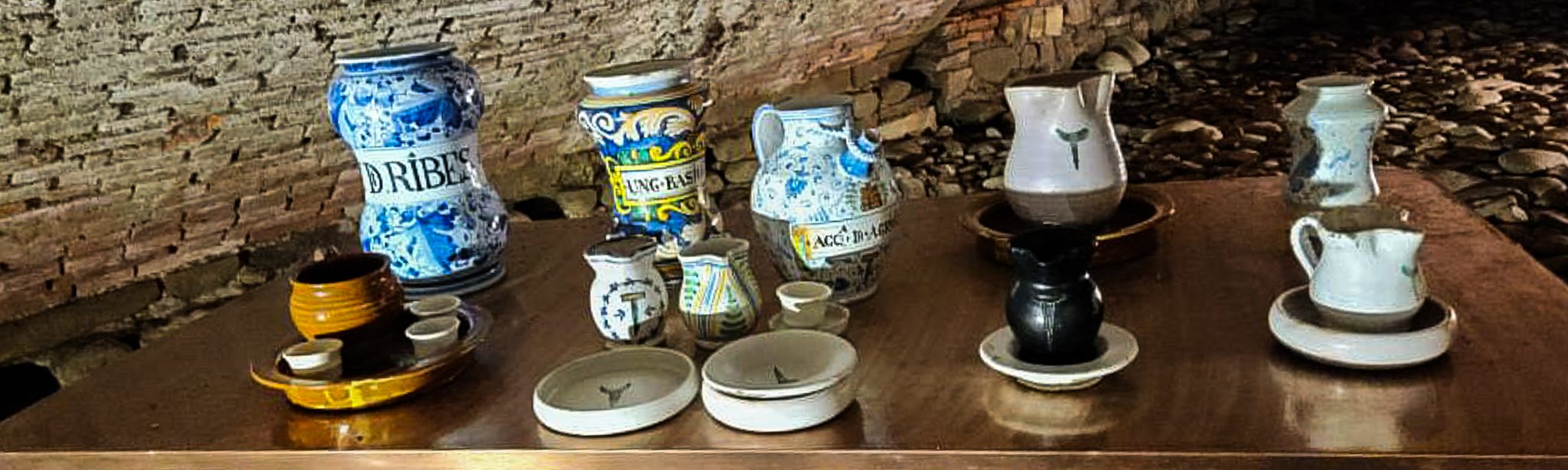
From there, she went into a long discussion about the old hospital “Ospedale del Ceppo” founded by a cloister of nuns who originally began it as a women’s shelter. It then became a hospital during the Plague. At some point, around 1400, Pistoia was conquered by Florence, and that government took over the hospital operations. So…. from the archeological finds of pottery, they can place a rough date of manufacture by the stamp it has on it. The one you see here is the stamp of Florence, so was made post-1400. Anything earlier would be from the Pistoia-era and older. I didn’t get a picture of the Pistoia image although there is one in one of the articles above.


Interestingly, all of the refuse from the hospital, the plague-infested patients’ dishes and cookware, etc… were tossed into the river, as it was used for sewage and garbage. This flowed straight to where the women washed clothing; we all know what happens when Plague cooties get spread into water sources. No wonder half the population died. It didn’t help that the sick shared up to 4 to a bed!
Our guide continued on and pointed out the area where another water wheel was used to operate a forge. Amazingly, farm tools were made there until only 40 or so years ago!! Say WHAT?!


On our way back we, passed a few side tunnels. I’d have given my right arm to be able to go exploring on my own!! (I’m left-handed.)


With that, our hour-long tour was over, and we headed back to daylight.
