May 9, 2026, Pt. 2 of a Very Long Walking Tour
Below is a map of Part 1 of our Walking Itinerary for the Day for you to follow along. If you have limited time in Prague but want to see most of the major sites, but not necessarily tour them in depth, this might be a good route for you as well. (I’ll post the Pts. 2 and 3 maps in the coming chapters.)

In the last chapter, I shared how we got up early and saw what we wanted to of the Prague Castle Complex before heading back down the hill. I’d left off with us just finishing up St. Vitus’ Cathedral, but there was still more within the castle walls that we wanted to see before finishing up. We had bought tickets that included all of what we’d wanted called “The Main Circuit”, but for extra sightseeing, such as guided tours, permanent art galleries, and summer gardens, there are optional add-ons available.
https://www.hrad.cz/en/prague-castle-for-visitors/tickets
The crowds were already getting too people-y for our taste by 9:30 when we’d finished up St. Vitus’. The tour groups were showing up en masse clogging the walkways, and more importantly making a LONG line at the one and only restroom facility. I think I stood waiting for 15 minutes easily. Just a heads up, almost every toilet is going to cost you a Euro. Be prepared. You have been warned! I could have probably bought a small house with what we spent on toilets.

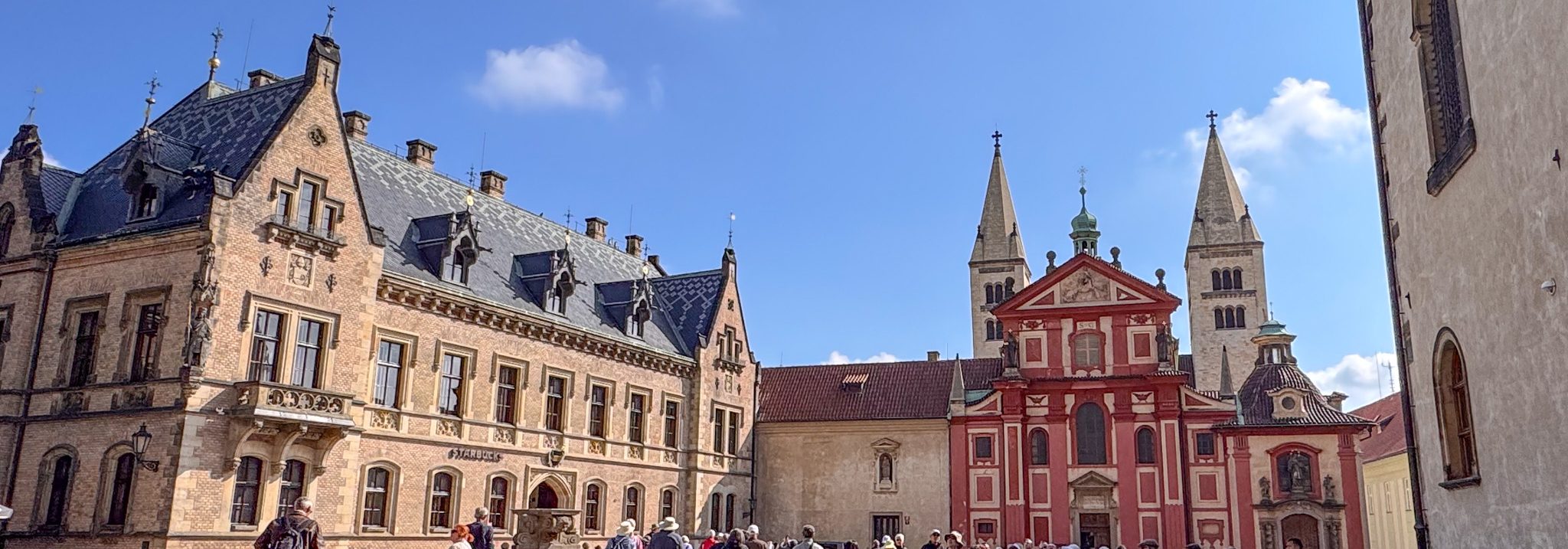
St. George’s Basilica was still on our list to see, so we made haste to see what we could. By this time we agreed to pick up the pace a bit so we could stay just a few more steps ahead of the crowd. St. George’s is one of the oldest churches in Prague with its construction starting in 920AD. In stark contrast to the Gothic and Neo-Gothic styles of St. Vitus’ that we’d just seen, St. George’s is solidly Romanesque. It is much more “basic” and clearly more austere, seemingly stripped of most of what once may have been in there. The differences in these two churches were almost jarring, however, what did stand out to me were the remnants of the original frescoes. I’d love to see how AI might re-imagine them as they once were. It is quite a bit smaller and there isn’t really much to linger over to see, so we took a few photos and moved on.


Should you be interested in learning more about St. George’s, Wiki is a great source.
The “Circuit” is fairly well marked and easy to follow. From St. George’s the next area to see is “The Golden Lane”. This is a well-preserved street from 15th century. It is located on the castle fortification walls and originally held the guards’ quarters and later shopkeepers’ rooms and shops. It is wonderfully turned into a museum-like little walk with re-created scenes and explanation signage. I loved this area so much and could have spent quite a lot longer there. But Prague has so much to see and our time was limited. Enjoy these few photos before we move off the Castle Hill, and towards the Danube…


I’ll also add that the Golden Lane has its requisite number of $hit$hops so you can pick up any manner of over-priced bric-a-brac should you care to. I should mention that I knew Franz Kafka was a big deal in Prague, but holy smokes, he is ubiquitous! When I mentioned that I was going to Prague to my 20-something year-old daughter, she got pretty excited. Did you know that Franz Kafka has been sort of resurrected in popularity amongst the Millennials and is widely read by them? Who knew a philosophical writer from the turn-of-the-century would appeal to that group?! On her recommendation I did listen to the audiobook of his most famous work, a short story called The Metamorphosis, and really enjoyed it. It’s a good read but yes, it is a bit heady and abstract. More Kafka coming up…

Going down is easier than going up, but the effort is more than worth it to see the Castle. My best advice is to get up early and “Rope Drop” that first thing in the morning. The crowd was becoming unmanageable by the time we were done there at 9:30 making photos harder and harder to get. As you come down, there is a perfect little viewpoint to see over the city. On the map above, it is the stop called “Prospect…” Truly, Prague is a gorgeous city, and it’s no wonder it’s called “The City of a Hundred Spires”. Just look at the view!


The most famous bridge, of the many, is the Charles Bridge, but our walking tour was purposely mapped out to cross over all four of its main spans which made for a bit of a “weave” through the city. I don’t regret doing it this way, as it gave us a really nice route to see a TON of Prague and the city with the Danube as a backdrop from many angles- like this one from the Svatopluk Čech Bridge, where you can see the Charles Bridge (Karlov Most) in the distance. Of note, all of them have lovely bronze statues to admire as you cross.

I won’t spend a lot of time here going in-depth on the various buildings we stopped to take photos of as we continue to make our way through the city as brief descriptions will suffice.
Like many cities in Europe, Prague was also home to many well-known classical composers including Dvořák. In fact, you can listen to his music played by the Czech Philharmonic in this building “The Rudolfinum” which is actually named after him. In fact, the main 1,148-seat auditorium is officially named the Dvořák Hall. I searched and searched for months for any live symphony music in ALL of the cities we’d be visiting, but every single time was thwarted just missing the concerts by only a day or two every. single. time. But there are surprises coming up in a not-to-distant chapter, so definitely stay tuned for that!!
Should you be interested in visiting or taking in a concert, HERE is a link to their official website.


This made us sad as we passed, senseless violence seems to be everywhere.

Along the way to our next real stop we passed some of the most lovely, post-WW1 architecture that still survives. This was an era when when Prague became a thriving cultural hub of Europe before the Great Depression. The Cubist style reigns and Art Deco and Art Nouveau influences abound. It’s truly a beautiful city to walk through and admire. Here are a few examples:


In my research, I found a ton of little treasures I wanted to stop and see, but knew I’d not have time for all. A few, however, ended up on our route even without my realizing that’d be the case like this fun and funky bronze statue unsurprisingly called “Statue of Franz Kafka” created by Jaroslav Rona in 2003. Its inspiration is from his 1912 short story “Depiction of a Struggle”, which, I’ll have to read now. LOL! When I posed for this photo, I knew it was another Kafka-inspired work but didn’t know the back story. (If you think we’re done with Kafka, you’d be wrong… stay tuned!)

Although our route did take us through a lot of the Jewish Quarter, all of its museums and synagogues, including the top attraction there, the Old Cemetery, were closed as it was Saturday. I was very sorry to have missed these and would put that area on the itinerary should I ever be back in Prague again.
All mornings with loads of walking should include pastry and coffee time. If you omit this important step, you’re doing it wrong. Let me show you why:
Yes, it was as delicious as it looks. Yes, we ate it all.

I’d researched “good bakeries” along our walking tour route and the NoStress Bakery, near the Jewish Quarter, got consistently excellent reviews. They had quite a few choices of both savory and sweet pastries, as well as made-to-order sandwiches and other goodies. It was busy in there and we ended up having to sit at a little counter against a wall which was fine. This was a good pick and I’d definitely go back!

Pkondz doesn’t enjoy coffee as much as I do, so he found a refreshing cold juice, I believe, and we both felt refreshed and recharged to keep on truckin’.
Next up: We cross the Charles Bridge (and a few others), enjoy more of Prague’s sights, and hang out with Kafka for a time…