May 9th ,2026- Pt. 3
We left off indulging in a mid-morning round of coffee and apple tart. Why not? Vacation calories absolutely do not count. Besides, by now, Limpy and Gimpy Hobbleson were about 10,000 steps into the day. Each successive one would hurt exponentially. Tylenol and Ibuprofen are the usual nightcap when the day is as long as this one was.
Here is the map of Part 2 of our long day’s route:


After our little break, we were sufficiently re-set to carry on. From the first bridge, we made our way towards the 2nd of the day- this one much more well-known. After the bakery, we tightened our laces and made way for the busiest, most crowded, claustrophobic place in Prague. But we made a quick stop by the Senate Building where stands a bit of an off-the-beaten-path oddity- The Dripstone Wall. I’ll let you read the informational plaque about this freak of architecture.


If you’re interested in a quieter, quite lovely stroll through manicured, French-sytle gardens this is the place to head. Additionally, The Senate Pavillion hosts regular, FREE classical concerts in the summer months; the string groups play a variety of artists. With limited time, we weren’t able to take in a performance, but I sure would have loved to!


Now, onto a bit of overly crowded space… but first, as we made our way there, another cute little photo spot caught my eye:

This is something that I’d put on a very long “I’d kinda love to see that” list and, as luck would have it, I got to after tossing it off the route as it was less of a priority among other things. Still, it was a nice little treat to still get to see it, even if from an angle I hadn’t counted on. Huzzah!! Sometimes, it’s the little things. This is a Vodník (a Czech water goblin or water sprite) from traditional Slavic folklore sitting by the giant Grand Priory Watermill on the “Devils Canal or Stream”. The goblin’s name is Kabourek and is one of the 40 legendary water goblins that lives in the Vltava River. Here’s the story:
Local Prague legends say that roughly 40 water goblins live in the Vltava River, and Kabourek is one of the nine who live specifically in the Čertovka canal. He is known as a somewhat grumpy but generally friendly creature who famously smokes a pipe and helps local fishermen in exchange for tobacco.
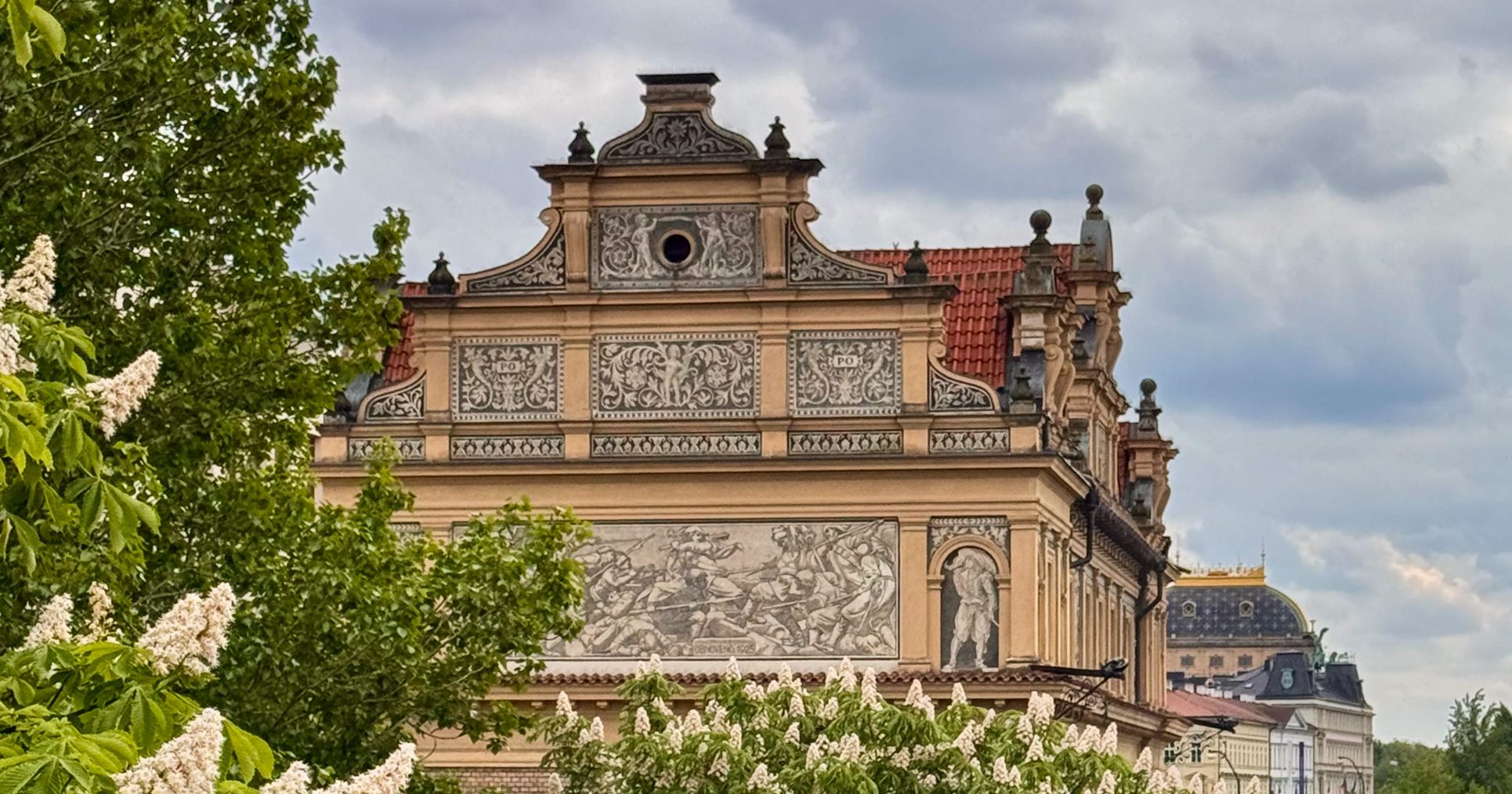
On the way to the 3rd of the 4 bridges we’d see, we also spotted the Bedrich Smetana Museum housed in the Old Town Waterworks building. Of Neo-Renaissance style sporting the most exquisite sgraffito exterior…. sigh, I’m in love. Just gorgeous. (If you’re curious, Bedrich Smetana is known as the Father of Czech Classical Music.)

After a few more blocks, the famous Charles Bridge came into view- obscured by approximately 50,000 other tourists who wanted to walk across it.


Truly, it is a work of art in itself, but the sculptures placed at regular intervals along it make it an almost museum experience. Here is an exceptionally fun fact about this bridge:
“According to historical records, Holy Roman Emperor Charles IV personally laid the foundation stone on July 9, 1357, at exactly 5:31 AM. This specific time formed a symmetrical numerical sequence (1357-9-7-531) that royal astrologers believed would grant the structure strength and longevity.”
Maybe they were right… it still holds up the collective weight of every tourist in Prague at the same time 669 years later.


Now… I’m an 80’s girl who grew up in SoCal and Alternative Music was most definitely my jam. Alongside Oingo Boingo, The Cure, and Bronski Beat, Depeche Mode was personal favorite band. In 1988, while that group had a politically important concert in Prague, at that time still behind the Iron Curtain, they did a cool photo shoot. One photo ended up being quite the pop culture icon. It was taken in front of the Lamentation of Christ sculpture on the bridge. I HAD to do my own recreation of this little piece of history and had the perfect travel partner to help me!
Behold… an ode to Depeche Mode.

Did I enjoy the stroll across the bridge? I’m glad we did it. But, was it MORE amazing than anything else we’d seen in Prague that day?
No.
From there we weaved and wandered a bit more taking in the wonderful mix of architecture styles, from Neo-Baroque to Gothic. It’s just so polar opposite of anything I’d ever see where I live which made the walk that much more fun.


It didn’t seem too long at all before we arrived at The Old Square, aptly named as it is the oldest square in Prague. Several very popular sites are here including the Astronomical Clock and The St. Nicholas Church, both of which we stopped at to take in a bit more.
The St. Nicholas Church is both beautiful and FREE!!! This, compared to its namesake “sister” church in Mala Strana that we’d seen at the Castle Complex, is wowza ornate. Truly a work of art that was well worth the visit.


We saw many of Prague’s squares that day, but this one hosts several bangers for attractions.

The mid-day panorama shows a bustling space with folks out enjoying a picture perfect day, probably most of whom were headed to the next spot we stopped at- the Astronomical Clock.
People jockey up to this, admittedly, very cool contraption up to an hour before its hourly “show”. We did not, as there were loads more places we wanted to see before we ran out of touring time. While I’m sure it’s an incredible sight to see with its many features moving and dancing (quite literally) we snapped the photos we wanted and moved on. Yes, the little dancing skeleton would have been a highlight for me.


Just for a bit of history and background, AI had this to say,
“The Creation and the Legend
- The Real Creators: For centuries, people believed the clock was built in 1490 by a master clockmaker named Jan Růže (also known as Hanuš). However, historical documents discovered in 1961 proved the clock was actually crafted in 1410 by clockmaker Mikuláš of Kadaň in collaboration with Jan Šindel, a professor of mathematics and astronomy at Charles University.
- The Dark Legend of Hanuš: A famous dark folktale claims that when Councilor Hanuš rebuilt the clock in 1490, Prague’s city leaders grew terrified he would build an even more beautiful clock for another European city. To protect their monopoly, they broke into his workshop and blinded him with iron rods. In revenge, the dying Hanuš allegedly threw himself into the clock’s complex gear mechanism, breaking it so badly that no one could fix it for over a hundred years.
Evolution of the Moving Figures
The clock was updated over different eras to add the automated figures that draw massive crowds today:
- The Original Dial: In 1410, the clock only had the mechanical astronomical dial and the tracking components.
- 17th Century Additions: The striking moving figures on the outside—including the iconic skeleton representing Death—were added to symbolize human vices and mortality.
- 19th Century Apostles: The wooden statues of the Twelve Apostles, which rotate past the upper windows every hour, were installed during a major repair between 1865 and 1866.
World War II Destruction and Modern Rebirth
- The 1945 Fire: On May 8, 1945, during the final days of World War II, the German military directed heavy anti-aircraft fire at the Old Town Hall to suppress the Prague Uprising. The building caught fire, the tower collapsed, and the astronomical clock suffered catastrophic damage. The wooden Apostles burned completely to ashes.
- The Miracle Restoration: While many experts believed the clock was permanently ruined, local master clocksmiths painstakingly reconstructed the entire internal iron mechanism. Sculptor Vojtěch Sucharda carved brand-new wooden Apostles from linden wood, allowing the clock to start ticking again by 1948.
- Recent Updates: In 2018, the clock underwent an extensive renovation to remove inaccurate post-war repairs, replacing the calendar dial with a faithful replica of the 19th-century master artwork by Josef Mánes.
Pretty cool stuff, if you ask me!
Another nearby old church is Our Lady of Tyn with the rising twin Gothic Towers you see in these photos:


Again, with limited time, we passed on this one too. There’s only so much time and there are hundreds, okay maybe dozens, of beautiful churches in Prague, all of which I’m sure are worth seeing. But the prominent rising towers certainly make a statement on the Prague cityscape! Afterall, it is the City of a Hundred Spires.
I’ll pick it up again with Pt. 4 of our long, long day of touring Prague. Yes, you can see a LOT of what this amazing city has to offer. But you have to get up early, make tracks, and yes, your touring will, for the most part, be somewhat surficial. But, I was after a “taste of” trip and was very happy with what I came away with. But! Lots still ahead before this day was over! Join us next time for Art Nouveau, Mucha, Kafka, and some furry critter interactions!
Meantime, it would be so awesome if you could hit the like button for me! This is a baby blog that needs a lot of love to grow!