The drive from Budapest—where we’d spent two lovely days exploring, which you can read about starting HERE—was an easy four-hour journey. If you’ve been following along, this was the first official leg of our COMPLETELY retooled itinerary.
Our Massive Europe Rental Car Mistake–
For those of you just joining us, the chaos started when we picked up our car in Prague a couple of days earlier. We were casually told at the counter that our vehicle could not be driven into four of the ten countries we’d planned to visit…. SAY WHAT?!?!
Yes, out of all the thousands of hours of planning we’d poured into this trip—from hotels and routes to not-to-be-missed sites—it never occurred to either of us that a rental car picked up in Europe couldn’t actually be driven throughout Europe. Learn from our mistakes, guys: that is simply not the case. Often, a car rented in the EU must STAY in the EU.
After exhausting every possible workaround at the National desk, including sprinting to the other rental agencies at the Prague Airport, it became clear: visiting Romania (a HUGE portion of our trip), Bosnia-Herzegovina, Montenegro, and Serbia was simply off the table. We’d only planned on a single night in a small Serbian town as a pass-through, so losing that wasn’t a big deal. However, having to forego several nights in Romania was a massive disappointment. We were both incredibly eager to see Peleș and Bran Castles and the stunning countryside.
Instead of relaxing, our two evenings in Budapest were spent completely revamping our itinerary on the fly. Could we salvage ANY of our hotel deposits? Could we adjust the route so we could still see Kotor, Montenegro? Exactly how much money were we going to lose over this deeply annoying debacle?
Luckily, we are both seasoned travelers. We quickly mapped out what promised to be a fantastic alternative schedule for our remaining two weeks, and we were honestly proud of what we came up with on such short notice. We would follow the rental car rules to the letter AND still fit in a few highlights we thought were completely lost to our oversight. And more importantly, we added what turned out to be the most absolute highlights of our trip to come!!
Spoiler alert: We did have to scrap Romania entirely, and since our only goal in Bosnia was a quick photo op at the Stari Most Bridge, that wasn’t a heartbreaking loss. But we did manage to salvage Kotor! Stay tuned for that later in the trip—you absolutely won’t want to miss our incredible stay in that beautiful city.
Back to Zagreb!

Arriving at the Casablanca Boutique Hotel–
We arrived at our hotel, The Casablanca Boutique Bed and Breakfast, and navigating our way there was an adventure in itself. Between the crisscrossing tram tracks, confusing one-way streets, and heavy traffic, it took some serious effort to actually locate and pull into the tiny, hidden driveway. Once we finally made it through, we found ourselves in an oddly run-down parking courtyard that made me a bit nervous about what we might find inside.
Luckily, our worries vanished the moment we stepped through the doors. The interior was clean and welcoming, and best of all, the staff had been incredibly accommodating. They worked with me to change our booking dates on incredibly short notice, since Zagreb was a stop we’d originally planned for much later in the trip. I was immensely grateful. This is the true beauty of traveling during the shoulder season—prices tend to be lower, and hotels have far more flexibility to help you out when plans go sideways.


First Impressions of a Capital in Transition–
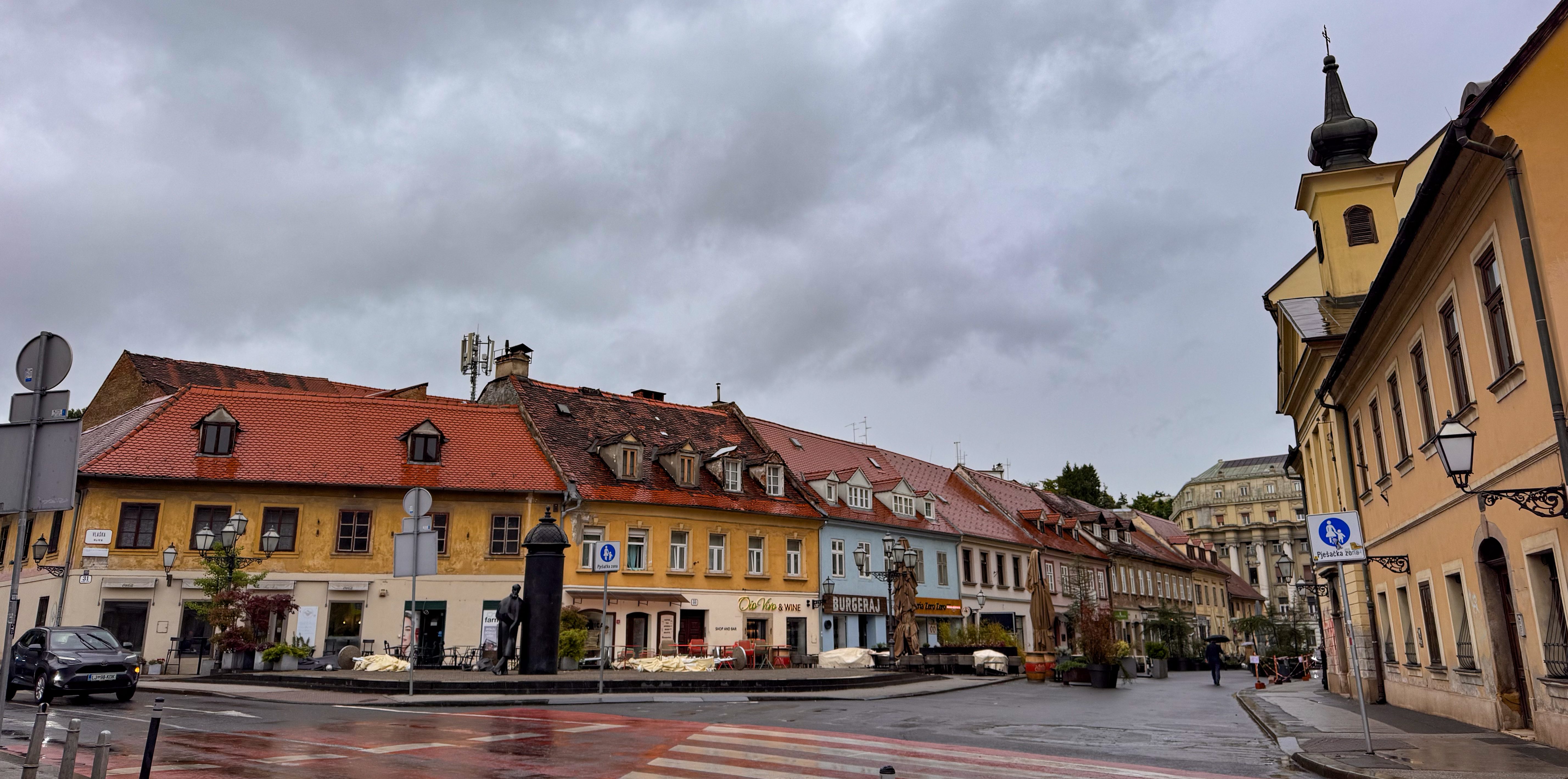
We arrived a little before 3:00 PM, leaving us plenty of time to take a long walk and explore this “city in transition.” Zagreb stirred up a complex mix of emotions, but for me, it was mostly defined by a sense of sadness—or perhaps resignation.
While there were certainly signs of progress, which pkondz will dive into next, my own immediate observations as we strolled… the streets felt a bit heavy. Many of the buildings were in noticeable disrepair, wrapped in a dull grey tone that perfectly matched the cold, rainy afternoon. Walking through it, the city seemed to carry an overtone of less civic pride than what we had just experienced in the grand, meticulously kept streets of Prague or Budapest.


Our first destination was the famous Zagreb Cathedral, a visit that turned out to be both disappointing and fascinating. As someone who had been looking forward to capturing some iconic photos of its magnificent twin spires, I was instead met with a sight that looked like this:

As we approached, my heart sank a bit to see the entirety of the twin spires completely swallowed by scaffolding. The whole church was undergoing a massive, complex restoration project. While I know preserving history is incredibly important and fascinating in its own right, it certainly wasn’t the picture-perfect cathedral I had imagined when spending hours planning this trip.


It turns out the reason for the extensive restoration was a series of back-to-back tragedies. The cathedral had spent nearly three decades undergoing steady reconstruction following the damage and strain of the Croatian War of Independence in the 1990s. They were finally nearing the end of those long-term efforts when a massive 5.5-magnitude earthquake struck this already struggling city in March 2020. (And then came the C—-, the disease that shall not be named.) The intense tremors severely fractured the iconic towers, causing the tip of the southern spire to completely collapse and leaving the northern one structurally compromised. Now, backed by significant EU recovery funds, the entire structure is undergoing an extensive, modern refurbishment to stabilize it for the future.
Still, my mood was sour, and I just couldn’t help feeling underwhelmed, cold, and somewhat disappointed by the rainy day. Nevertheless, stepping inside the cathedral brought some welcome interest and physical warmth.

Because of the ongoing restorations, many of the church’s monumental elements had been carefully deconstructed, with the massive cathedral bells displayed right on the main floor.

But for me, the most fascinating piece of the interior was an enormous, mysterious inscription stretching across the wall that looked like this: At first glance, the geometric, angular symbols almost look like ancient Egyptian hieroglyphics!

However, it turns out this is actually something entirely unique to Slavic heritage: the Glagolitic script, the oldest known Slavic alphabet, created back in the 9th century. For those of you who might be curious about what it actually says, it translates to a beautiful dedication commemorating the 1,300th anniversary of the baptism of the Croatian people, pledging their eternal devotion. I don’t recall ever seeing a linguistic treasure quite like this in any other church throughout my travels, and it completely transformed my view of the interior.
Back outside in Zagreb’s seemingly apathetic vibe, we noticed the cathedral’s giant clockface and a pretty little fountain sitting nearby in the square.


Zagreb’s historic center is incredibly compact and easily walkable, though it does require tackling some considerable hills to move between the Lower and Upper Towns. As we climbed, we passed through the Stone Gate, slipping into an atmospheric passageway built into the ancient city walls. Stepping inside felt like stepping straight back in time. The gate houses an active, deeply revered little chapel where we watched a woman quietly offering prayers and lighting a candle in the dim glow.


As we emerged into the square where St. Mark’s Church stands, my hopes for a picture-perfect moment were dashed yet again. We were met with this frustratingly familiar scene:

UGH! Iron fences, construction trailers, and heavy equipment completely blocked off the square. Despite the barriers, I had to admit the roof itself was stunning. It still boasts its iconic patterns crafted from vibrant ceramic tiles. While most of these tiles are modern replacements rather than the nineteenth-century originals, they remain an incredible piece of artistry that feels distinctively unique to the Balkans and Slavic history.

By the time we finished capturing what we could of the view, it was already after 5:00 PM. We realized that even if the historic building hadn’t been completely shuttered for ongoing structural renovations, we would have arrived too late to tour the interior anyway. With the daylight fading and the cold air settling in, there was nothing left to do but laugh at our timing and move along.

Zagreb offers, at least presently, an odd mix of quaint, old Europe and a distinctly edgy, raw aesthetic. The streets are lined with slightly crooked, seemingly haphazard architecture and old stone pathways, which are frequently pierced by dingy alleys “decorated” with heavy graffiti and crude street art.

As we navigated the winding paths and staircases, the imagery grew even more bizarre, featuring walls lined with stencil art like this assembly of dancing skeletons (yes, I did chuckle.):

In the dimming light of a misty afternoon, parts of this old city began to give off a decidedly sketchy feel, adding an unexpected layer of grit to our visual tour.
The last sites on our short list of things we wanted to see in Zagreb were the “odd” WWII tunnels that criss-cross the city which I thought might offer some good photo opps, but my heart just wasn’t in it. It was getting chillier and it was really time to find some dinner by then. This was the best I managed, and don’t know which entrance it is:

On the way to find a good place to eat, we continued along the edge of the Upper Town, where we arrived at the imposing Lotrščak Tower, which stands right alongside a charming, bright yellow historic building. This medieval tower is famous for housing the Grič Cannon, which has blasted from its top window at exactly 12:00 noon every single day since 1877—originally to help the city’s church ringers synchronize their bells, and now to terrify unsuspecting tourists. Since we arrived well past 5:00 PM, the cannon was long quiet, but the spot offered wonderful view over the city for a bird’s eye view.


Tasting Authentic Croatian Cuisine at Stari Fijaker-
Cold and damp from our walk, we were more than ready for a hearty dinner. We had previously asked our lovely hotel hostesses where we could find the most authentic Slavic fare in the city, and without hesitation, they pointed us toward Stari Fijaker Restaurant.

We were definitely NOT disappointed! The food was absolutely fantastic, serving as the perfect antidote to a chilly afternoon. I don’t recall exactly what pkondz ordered, but mine was an outstanding dish of traditional stuffed peppers paired with a wonderful glass of Italian wine—a delicious reminder that Italy sits just across the Adriatic Sea.


To top off a fantastic meal, we ordered a slice of warm, homemade Štrudla od trešanja (cherry strudel). A delicious legacy of Zagreb’s Austro-Hungarian past, the flaky pastry was packed with tart cherries and dusted heavily with powdered sugar—the ultimate comfort food to end our rainy day in the city.

Our trek back to the hotel turned out to be a fun, easy journey in itself. Before we had left the Casablanca earlier that afternoon, the ladies at the front desk had given us some incredibly helpful information on which tram to catch from the city center and exactly how to pay for it. It was easy-peasy. Almost all stops have a little kiosk or shop nearby for purchasing tickets and we had no trouble at all. For a very reasonable €0.53 each, the tram offered a warm, dry ride straight back to our cozy boutique hotel. The stations have digital readers which tell you exactly when each train is expected and we found this to be accurate to the minute. They are clean, on-time, and easily affordable.


As we settled into our restful room for the night, the reality of our new adventure began to set in. Tomorrow’s drive would take us to Pula—the very first city on our itinerary that had been wholly unplanned until a mere three days prior. What would this unexpected coastal town hold for us? Come back next time for some giant surprises!
Want to start from the beginning of this epic, adventure-filled Balkans Vacation? Start with us in Prague, and follow along as we work our way through Budapest, Zagreb, Pula, Split, Dubrovnik, Plivitce, Kotor, Lublijana, and Salzburg! Here’s a link to get your started!
It would mean the world to me if you “Liked” and Subscribed; it’s a joy for me to share one adventure after another with folks who love to travel as much as I do!
One response to “Zagreb: A City in Transition- My Honest First Impression”
[…] us as we make our way to Zagreb- A City in Transition, an Honest Opinion of First Impressions. We head there next after our fantastic wonderful couple of days in […]