We are travelers who revel in finding the road less-oft explored. Our love of studying maps to uncover hidden treasures paid off big time on our journey from Zagreb to Pula, yielding a destination whose history couldn’t be more fascinating! If you want to catch up on the full itinerary of our amazing, 2.5-week road trip through Central Europe and the Balkans, you can explore our complete multi-country guide. On our previous stop, we were busy exploring Budapest’s legendary ruin bars, indulging in authentic chicken paprikash at Getto Gulyás, and taking in a breathtaking string concert inside the exquisite St. Matthias Church. Or, if you’re interested in heading to Zagreb, you can read about our honest impressions here.
Almost exactly an hour after leaving Zagreb, we turned off the main highway onto a little-used, quiet country road. This unbelievably wonderful time capsule is tucked away where few have ever taken the detour to explore—and now, fewer still will have the chance, as it has officially been closed to the public. As the trees thickened into a dense canopy, a shadowy monolith materialized out of the wilderness. Towering stone walls, elegant balustrades, and a prominent round tower cloaked entirely in heavy ivy announce your arrival at Stari Grad Bosiljevo.


The Hollywood Tower of Terror Vibe in Croatia-
While its roots date back to the 14th century, Bosiljevo doesn’t feel like a dark, gritty medieval outpost. Instead, it screams fading wealth. Stepping across the threshold gives you an immediate, spine-tingling Hollywood Tower of Terror vibe. It is a haunting monument to elite elegance, frozen mid-decay.
This overwhelming aura of posh luxury is the legacy of the Cosulich de Pecine family, wealthy shipping magnates who purchased the estate in 1911. They spared no expense, spending the 1920s and 1930s transforming the ancient stronghold into an ultra-upscale private palace. The family held onto their grand villa until 1948, when the communist government nationalized the property. We arrived in the quiet, liminal space right after modern padlocks were snapped into place for a new renovation project, catching the absolute final curtain call on its era of abandonment. Should you be interested in the complex history of this property, Wiki has a pretty thorough run-down including the Frankopan ruling families, and prior to the Cosulich’s, the Irish-born Laval family.


The absolute epitome of a Hollywood Tower of Terror vibe. These narrowing, arched corridors and peeling pink plaster walls look exactly like a gilded-age hotel frozen mid-decay.
Urban Exploration in a Gilded-Age Ruin–
Fences in the Croatian countryside have a way of remaining porous. Finding a small, weathered gap in the perimeter gate—an opening just wide enough to squeeze through—the barrier between the modern road and the palace grounds dissolved. Slipping inside felt less like a trespass and more like stepping into a decaying fairytale.
The silence within the courtyard was total, thick with the scent of damp stone and undisturbed dust. An old, iron-topped stone water well sat choked in deep brush. Moving inside, we navigated a cavernous maze where grand doors had been thrown completely off their hinges, leaving the paths wide open to the elements.

Beneath the crumbling opulence, however, a much darker, distinctly eerie undercurrent runs through the property. Stripped of its high-society warmth, the estate forces you to tread lightly. Pitch-black cellars yawn open beneath the floorboards—the kind of damp, forgotten cavernous spaces where you can practically hear the rustle of bats disturbed by your footsteps. Between the gaping, uncovered courtyard wells and structurally compromised stone steps, it is admittedly a very hazardous environment. For any fellow travelers tempted to seek out this hidden relic, extreme caution is a non-negotiable requirement. Floors can give way without warning, and nature has spent decades turning this decaying palace into a beautiful but unforgiving labyrinth where one wrong step could end your trip entirely.

The Intact Posh Interiors of Bosiljevo Castle–
Stepping into the residential quarters, the castle walls suddenly gave way to airy, powder-blue vaulted galleries and grand corridors. On the walls, layers of peeling plaster revealed elegant, hand-stenciled gold floral patterns—a stark contrast to the rough stone fortification outside.

In a grand reception salon, an incredibly ornate, neo-Baroque fireplace mantle detailed with gold trim and green faux-marble stood wrapped in protective construction plastic. It was a beautiful, ghostly indicator that the estate’s high-society past is finally being cataloged by preservationists.

Such elegance even included indoor plumbing!

Discovering the Faded Chinoiserie Frescoes–
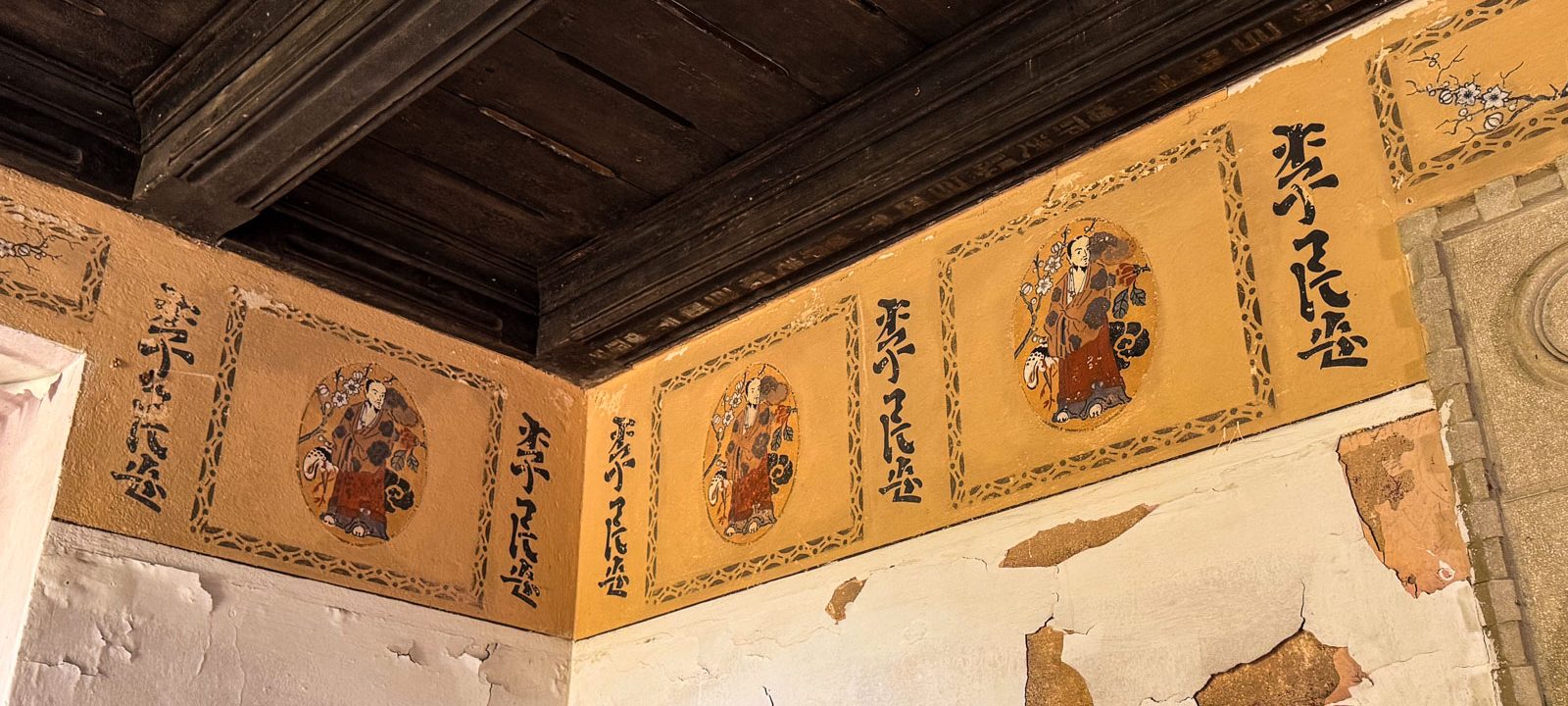
The ultimate display of eccentric wealth waited just below the dark wooden ceilings of an upper salon. Looking up at the peeling plaster, we gasped. Still clinging to the walls was a vibrant, hand-painted border of 19th-century chinoiserie frescoes and hand-stenciled wall-decor. Figures in traditional oriental robes looked down upon the decay, entirely exposed to the humid air but remarkably intact.


Up close, the craftsmanship is remarkable. These delicate patterns survived decades of abandonment and damp air, keeping the gilded spirit of the Cosulich era alive.Ghostly Records of a Forgotten Era–
As we explored deeper into the rooms, the castle continued to yield its secrets. On an old, green-painted wooden louvered shutter panel, we stumbled upon a striking crossroads of history. The underlying layer of the woodwork contains a meticulously grid-lined property manifest—a literal bureaucratic footprint from 1948 when the communist government nationalized the estate and clerks used the building’s own architecture as a makeshift inventory ledger. Decades later, a local protest artist used that exact same formal calligraphic script to layer a scathing commentary directly over the state’s inventory lines. Inking words like Kulturocid (cultural crime) and vladnih interesa (government interests), they beautifully hijacked the original property document, turning a piece of state bureaucracy into a timeless protest against the decades of neglect that followed.


A final glimpse of the peaceful wilderness surrounding Stari Grad Bosiljevo before stepping back through the fence and returning to the 21st-century highway.Join me next time
Leave a Reply